
How the UAE-Nigeria Partnership Can Transform Our Ports
The UAE and NPA Partnership
By Ibrahim Nasiru
For many years, the conversation surrounding Nigerian ports has been dominated by complaints about delays, high clearing costs, and poor infrastructure. Importers, exporters, and clearing agents struggle daily with manual processes that slow down the movement of goods. However, a major diplomatic movement at the Nigerian Ports Authority (NPA) Headquarters in Lagos suggests that a practical solution is finally on the horizon.
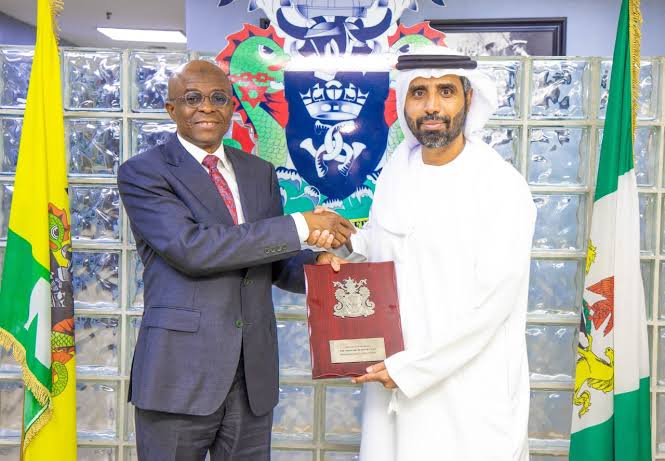
The recent official visit of the United Arab Emirates (UAE) Consul-General, His Excellency Salem Al-Jaberi, to the NPA Managing Director, Dr. Abubakar Dantsoho, represents a significant shift in how Nigeria intends to manage its maritime economy.
This was not just another polite meeting for the cameras; it was a deliberate step toward turning long-standing diplomatic promises into real economic assets. Nigeria is finally moving away from simply signing agreements to aggressively operationalizing them.
To understand why this partnership matters, we must first look at the biggest problem facing Nigeria’s trade sector: our heavy reliance on crude oil. For decades, successive governments have talked about diversifying the economy and boosting non-oil exports like agriculture and solid minerals.
Yet, whenever local businesses try to export their goods, they are frustrated by bottlenecks at our maritime gateways. By aligning with President Bola Ahmed Tinubu’s economic goals, the NPA is trying to use the UAE’s massive wealth and logistics expertise to clear these bottlenecks and give Nigerian exporters a seamless path to global markets.
The core of this new relationship is the partnership between Nigeria’s Ministry of Marine and Blue Economy and the AD Ports Group. The UAE has some of the most advanced and efficient ports in the world, managed with cutting-edge technology and massive capital.
Bringing that capital and technical expertise into Nigeria’s local port infrastructure will completely change the game. We are looking at a future where our berths are modernized, our channels are constantly dredged, and our cargo-handling equipment matches global standards.
Crucially, this partnership offers a golden opportunity to finally solve the long-standing problem of our dormant Eastern and Delta ports. For too long, national trade has been dangerously choked because almost everything is forced through Lagos, leaving gateways like Onne, Warri, and Calabar underutilized.
By deploying the AD Ports Group’s proven expertise in managing multi-port networks, the federal government can channel UAE investment directly into dredging the shallow channels of the Delta, upgrading security infrastructure, and building modern deep-sea capacity outside Lagos.
Related Posts
Reviving these Eastern gateways with world-class logistics technology will instantly lower transport costs for merchants across the South-East and South-South, balance national cargo distribution, and ignite massive economic growth in regional business hubs.
Beyond physical infrastructure, the most critical part of this deal is the focus on digital trade solutions. Right now, it takes far too long to clear a container in Nigeria compared to modern ports in Asia or Europe. Manual inspections, redundant paperwork, and human interference create room for corruption and delays.
The UAE’s commitment to help Nigeria build a robust digital logistics infrastructure will automate these processes. When port clearance becomes automated, delays drop, transparency increases, and the cost of doing business falls drastically for Nigerian importers and exporters.
Furthermore, this engagement ties directly into the broader UAE-Nigeria Comprehensive Economic Partnership Agreement (CEPA). In simple terms, this framework is designed to lower trade barriers and make it easier for businesses in both countries to interact.
When you combine lower trade barriers with efficient, digitized ports, you create an economic ecosystem where local businesses can thrive and compete globally.
The truth is that Nigeria does not lack natural advantages. We have the coastline, the strategic geographical location, and a massive population of creative, hardworking entrepreneurs. What we have lacked is the structural efficiency to back up these advantages.
The UAE has the capital, the technology, and the proven blueprint for maritime success; Nigeria has the market and the potential.
This partnership should be pursued with absolute focus and transparency. The NPA leadership under Dr. Abubakar Dantsoho must ensure that these discussions quickly translate into physical projects at our ports.
We have signed enough papers in the past. What the maritime industry needs right now are modern scanners, automated clearing systems, and fluid trade corridors. If we can successfully execute this blueprint, we will not only fix our ports, but we will also unlock the true wealth of Nigeria’s blue economy.
Ibrahim Nasiru is A Public Affairs Analyst