
NPERA: “We Are Empowered And Set To Revolutionize Port Operations In Nigeria”-Akutah
NPERA: We Are Ready and well Prepared To Enhance Port Operations-Akutah
On August 13, 2026, President Bola Ahmed Tinubu signed the Nigerian Ports Economic Regulatory Agency (NPERA) Bill into law, ending the era of the former Nigerian Shippers Council’s temporary oversight and giving Nigeria an Agency to oversee its ports and strengthen commercial issues.
Nigeria now have an official watchdog for port operations as the country enforces a major paradigm shift in ports economics, a development long awaited by port operators since the port concession programme of 2006.
Before the emergence of NPERA, the Nigerian Ports Authority (NPA), managed the ports as landlord and technical regulator. The absence of an agency y to oversee the financial aspects like fees, charges, competition, and resolve disputes was a source of worry.
Recall that in 2014, the government appointed the Nigerian Shippers’ Council (NSC) as a temporary Port Economic Regulator. inasmuch as the NSC performed this role based on a 2015 order, its authority was often challenged because it had no legislative backing-leading to uncertainty for industry players as Shipping lines, freight forwarders, terminal operators and many port users were plagued by rising charges and long dispute matters
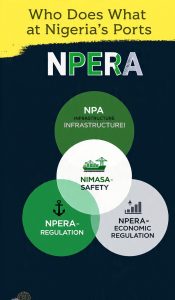
NPERA will not be taking over port management. The NPA will continue to handle infrastructure, dredging, and landlord responsibilities. While NIMASA is in charge of safety and maritime administration, NPERA’s focus will be solely on economic matters such as reviewing, approving, monitoring port tariffs, rates/charges and ensuring no operator dominates the port businesses.
NPERA is now saddled with setting standards for port service providers while enforcing efficiency and transparency in service delivery as well as providing binding decisions on commercial disputes between port users and service providers.

Dr. Ibrahim Shema, Chairman of the NPERA’s Governing Board, described the coming of NPERA as a major reform designed to promote transparency, fairness, predictability, efficiency and accountability.
From available data, in the fourth quarter of 2025 alone, maritime trade was valued at approximately N35.4 trillion. Sea transport accounted for 98.58% of exports and 96.81% of imports. Given this volume, even minor inefficiencies at the ports can significantly impact the entire economy.
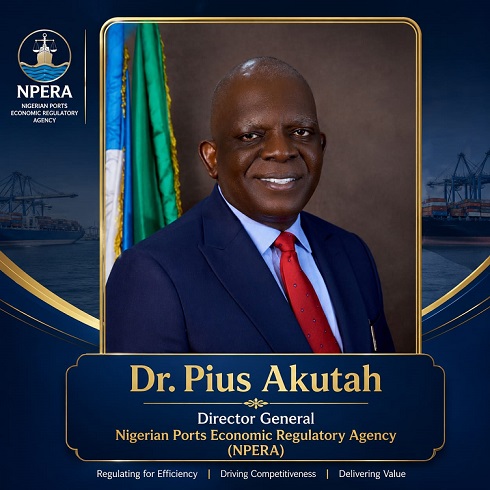
Director General of NPERA, Dr. Pius Akutah is ecstatic and grateful to President Bola Ahmed Tinubu for assenting to the NPERA Bill after many years.
“The NPERA Act has strengthened our regulatory powers to institute effective regulation at the ports. With this mandate, we are positioned to drive efficiency, transparency and competitiveness in the port sector” Akutah said
Related Posts
He further stated that NPERA will strive to contribute meaningfully in achieving the $1 trillion economy as envisioned by President Tinubu.
Dr. Akutah further disclosed that NPERA shall ensure competitive ports, efficient terminals, transparent charges, reliable shipping services, modern customs processes, digital systems, efficient rail, inland-waterway connections and a strong regulatory framework.
“The objective should not be to force cargo away from one port towards another; rather, Nigeria should create a port system in which no port is favoured, no port is unnecessarily disadvantaged, and every viable port has the opportunity to compete for cargo on the basis of efficiency, cost, capacity and service delivery”
“The NPERA Act has strengthened our regulatory powers to institute effective regulation at the ports. With this mandate, we are positioned to drive efficiency, transparency and competitiveness in the port sector”.
He stated that the expanded responsibilities of the agency will contribute in a more significant way to the efforts of the Government to build a $1 trillion economy.
This, according to him, will be by creating a more predictable and friendly business environment in the ports.
“It requires a combination of competitive ports, efficient terminals, transparent charges, reliable shipping services, modern customs processes, digital systems, effective rail and inland-waterway connections and a strong regulatory framework”
“Our objective is not be to force cargo away from one port and towards another. Rather, Nigeria should create a port system in which no port is favoured, no port is unnecessarily disadvantaged, and every viable port has the opportunity to compete for cargo on the basis of efficiency, cost, capacity and service quality.
With the coming of NPERA into Nigerian Ports, concerns about overlapping responsibilities between NPERA, NPA, and NIMASA have been resolved.
According to Dr. Shema “The goal is not about creating competing authorities. It is about establishing a coherent system in which institutions work together, each within its statutory responsibilities.”
For Nigerian port industry, the message that comes with NPERA is clear: The time of temporary measures is over. Economic regulation now has legal backing. If NPERA successfully fulfills its mandate, Nigeria’s ports could become more affordable, efficient and competitive.
In an industry that handles almost all of Nigeria’s trade, this is more than just a policy success; it’s an economic necessity.