
NSDP, DEEP BLUE and Blue Economy Accelerator: Is NIMASA On Course?
NImasa commences Blue Economy Accelerator program

The Nigerian Seafarers Development Programme, NSDP, was introduced in 2008 by the Nigerian Maritime Administration and Safety Agency, NIMASA, with the sole aim of training Nigerian youths to become seafarers and Naval Architects in fulfilment of one of its core functions in the area of Maritime Capacity Building.

Under it immediate past Director General, Dr. Bashir Jamoh, the Agency said it placed 3,705 seafarers onboard Cabotage vessels in the year 2021, 7,238 seafarers placed in 2022 and 1,013 placed in 2023 (Jan – July).
“Overall, a total of 11,956 Nigerian seafarers have been placed onboard Cabotage vessels from January-2021 to July- 2023” NIMASA declares.
This is even as lamentations and protests by NSDP Cadets were so strident at a time that a NIMASA Management delegation had to travel to the Philippines, United Kingdom and other countries with a clear mandate to address their complaints and lasting solutions to their problems.

We heard then that three-four year NSDP courses were running for six to eight years and counting even as protests within and outside Lagos were a regular occurrence.
The Dr. Dayo Mobereola management seems to have brought stability to bear on NSDP related issues.

Few months back, NIMASA received some NSDP Cadets who have successfully completed and obtained their Certificates of Competency, CoC Certificates.
The NIMASA helmsman described the perseverance and dedication of the newly certified seafarers as an epitome of resilience and undying commitment to realizing a dream.
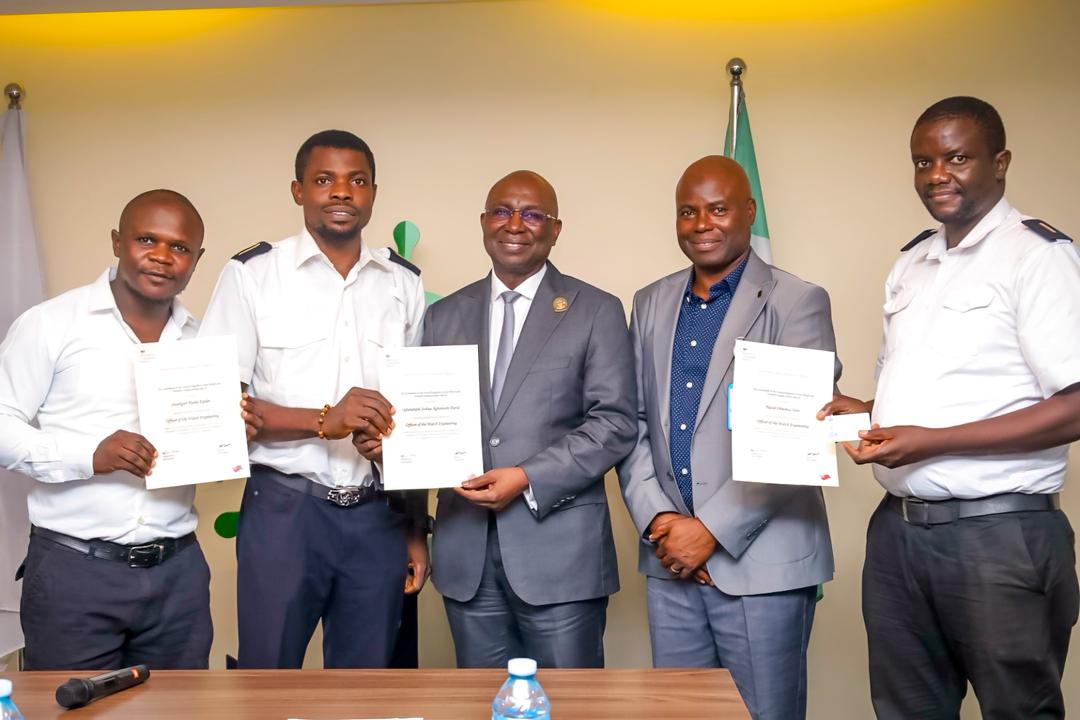
“While challenges may appear daunting, they can also present valuable opportunities for personal and professional development. You have faced adversity head-on; your future is now brighter” Mobereola said, parting the CoC holders on their backs.
The Integrated National Security and Waterways Protection Infrastructure, otherwise known as the Deep Blue Project is Nigeria’s homegrown solution to issues of maritime Safety and Security concerns affecting Nigerian Maritime trade and businesses years back.
The world has acclaimed Nigeria’s efforts, as accolades from global maritime professionals have been selflessly and unsolicitedly so, heaped on Nigeria in appreciation of the country’s huge investments in restoring safe navigation within Nigeria and the Gulf of Guinea region
Related Posts
Implemented by NIMASA to combat piracy, crude oil theft, and sea robbery while protecting critical maritime infrastructure, the Deep Blue project integrates land, sea, and air assets, including special mission vessels, aircraft, and armored vehicles, manned highly trained, combined security forces.
Relentless and untiring, NIMASA has introduced the Blue Economy Accelerator, BEA, which the Agency terms “A strategic initiative designed to identify, nurture, and accelerate innovative startups that will contribute to the sustainable growth of Nigeria’s marine and blue economy”
We are told that the BEA, is aimed at attracting young, vibrant minds with innovative ideas capable of transforming Nigeria’s maritime ecosystem.
The Director-General of NIMASA, Dr. Dayo Mobereola explains that through the BEA initiative, participants will receive structured business development support, industry mentorship, and technical guidance to convert promising concepts into viable ventures that address critical challenges and opportunities within the blue economy.
According NIMASA, “The programme reflects NIMASA’s commitment to supporting the implementation of the vision of the Federal Ministry of Marine and Blue Economy in unlocking the immense potentials of the blue economy by empowering young innovators, entrepreneurs, and technology-driven enterprises”
“We at NIMASA want to provide a platform for investors to identify young talents and invest in them”, the NIMASA Boss said
NIMASA says applications are open to startups and innovators developing solutions across several strategic sectors, such as Marine Waste Management, the Blue Circular Economy; Aquaculture And Sustainable Fisheries.
Also listed as available for innovators to explore are Maritime Technology and Logistics Innovation; Ocean Energy Including Wave, Tidal, and Offshore Renewable Energy.
Other areas to venture into as listed by NIMASA are Marine Tourism, Coastal Recreation; Marine Biotechnology-Ocean Data and Analytics; Green Shipping, Vessel Decarbonization; Smart Port Solutions; Autonomous Marine Vehicles; Biofouling Prevention Technologies as well as Coastal Resilience Through Nature-Based Coastal Defense Solutions.
While a portal has not been launched through which applicants can apply neither are there phone numbers given out for innovators to reach NIMASA officials, we think there are options which NIMASA could have explored to make this BEA more beneficial to the Blue Economy
For instance, once upon a time NIMASA had Study Chairs in selected Nigerian Universities such as UNILAG, OAU, UNIPORT and others. What happened to these study centres?
Could the BEA initiative be reversed into Maritime Research Centres, MRC, in Nigerian Universities? Are Nigeria Professors, well funded, incapable of discoveries which could support/galvanize the Blue Economy?
Water Hyacinth is a menace on Nigerian Coastal waters. Who say use/uses cannot be found for this sea weed which has made navigation very difficult for boat operators and ferry users within Lagos and other parts of the country? Do i hear you say “That’s outside NIMASA’s purview? Is the Blue Economy not all inclusive? Can success be isolated?
There are maritime professionals who are very knowledgeable, widely travelled and exposed to maritime development issues and strategies in the employ of NIMASA.
If the Blue Economy Accelerator is the way to go, let the engines roar as we look forward to innovations in maritime startups in Nigeria!