
UNBUNDLING THE PORTS: OYETOLA’S BLUEPRINT AND THE END OF AGENCY RIVALRY

By Ibrahim Nasiru
The recent technical discussions between the leadership of the newly transmuted Nigeria Ports Economic Regulatory Agency (NPERA) and the Nigerian Ports Authority (NPA) mark a critical turning point in the governance of Nigeria’s maritime sector.
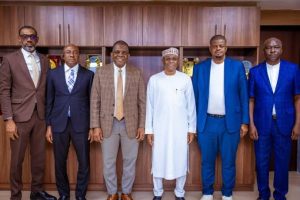
Prompted by a definitive ministerial directive from the Minister of Marine and Blue Economy, Dr. Adegboyega Oyetola, the two agencies are moving to operationalize the transfer of Inland Dry Port functions from the old Nigerian Shippers’ Council architecture straight to the NPA.
For decades, Nigeria’s maritime ecosystem has been severely suffocated by overlapping institutional mandates, administrative friction, and a counterproductive confusion over who regulates commerce versus who drives infrastructure.
By enforcing this sweeping separation of port economic regulation from core operational development, the federal government is finally addressing the structural flaws that have long stopped Nigeria from becoming the dominant maritime hub of West Africa.
Under the fresh provisions of the NPERA Act 2026, particularly the critical alignment of Section 51, the administrative boundary lines are being redrawn with clinical precision.
The old regime, which forced the Shippers’ Council to simultaneously act as an economic referee and an active promoter of inland dry ports, was an unsustainable model that created inherent institutional contradictions.
You cannot effectively police a commercial market while actively building and managing its operational assets. Shifting the promotion, development, and operational oversight of inland dry ports entirely to the NPA allows the authority to leverage its massive, existing deep-sea infrastructure and engineering competencies to rapidly scale up these hinterland Ports.
This clean realignment ensures that Inland Dry Ports stop being slow-moving administrative projects and finally become hyper-efficient logistics nodes that seamlessly extend the economic reach of our coastlines into the landlocked states of the North.
Related Posts

Consequently, the collaborative maturity demonstrated during the recent strategy session between NPERA Director-General, Dr. Pius Akutah, and the NPA Managing Director, Dr. Abubakar Dantsoho, signals a refreshing departure from the toxic inter-agency warfare that defined the past.
In previous dispensations, such a sweeping transfer of functions would have triggered fierce turf battles, with executives aggressively hoarding administrative powers to the detriment of national trade efficiency.
Akutah’s strategic proposal for a high-level joint committee—integrating NPERA, NPA, the National Inland Waterways Authority (NIWA), and the parent ministry, proactively tethers all moving parts to a single, accountable execution framework.
This coordinated approach is exactly what is needed to assure international shipping lines, domestic clearing agents, and private concessionaires that the transition will be frictionless, legally sound, and completely free from double-taxation trapdoors.
Ultimately, the successful execution of this structural unbundling will be the ultimate metric used to grade President Bola Ahmed Tinubu’s Marine and Blue Economy agenda.
If properly managed, freeing NPERA to focus strictly on economic regulation will create a fiercely competitive, transparently priced maritime marketplace that drives down the prohibitive cost of doing business at our Ports.
Simultaneously, placing the Inland Dry Ports within the NPA’s operational portfolio should accelerate cargo evacuation times, de-congest the chaotic Apapa and Tin Can corridors, and unlock the dormant multi-billion dollar trade potential of the hinterlands.
Minister Oyetola has laid down a courageous, legally backed blueprint for structural clarity. It is now up to the joint leadership of Akutah and Dantsoho to aggressively transform this institutional unbundling into a thriving, world-class economic reality.
Ibrahim Nasiru, a Public Affairs Analyst writes from abuja